ISO-like interoperability protocols for AI governance
ICML 2026 · 🏆 Spotlight
Position Paper Track
AI Risk Manifests
Machine-readable nutrition labels
AI Governance Needs ISO-like Interoperability Protocols, Not Just Laws
Azmine Toushik Wasi, Mst Rafia Islam, Mahfuz Ahmed Anik, Taki Hasan Rafi, Md Manjurul Ahsan, Dong-Kyu Chae
Computational Intelligence and Operations Laboratory (CIOL) •
Shahjalal University of Science and Technology (SUST) •
Independent University, Bangladesh (IUB) •
Hanyang University •
University of Oklahoma
Correspondence: dongkyu@hanyang.ac.kr
Accepted to the Forty-Third International Conference on Machine Learning (ICML 2026), Seoul, South Korea
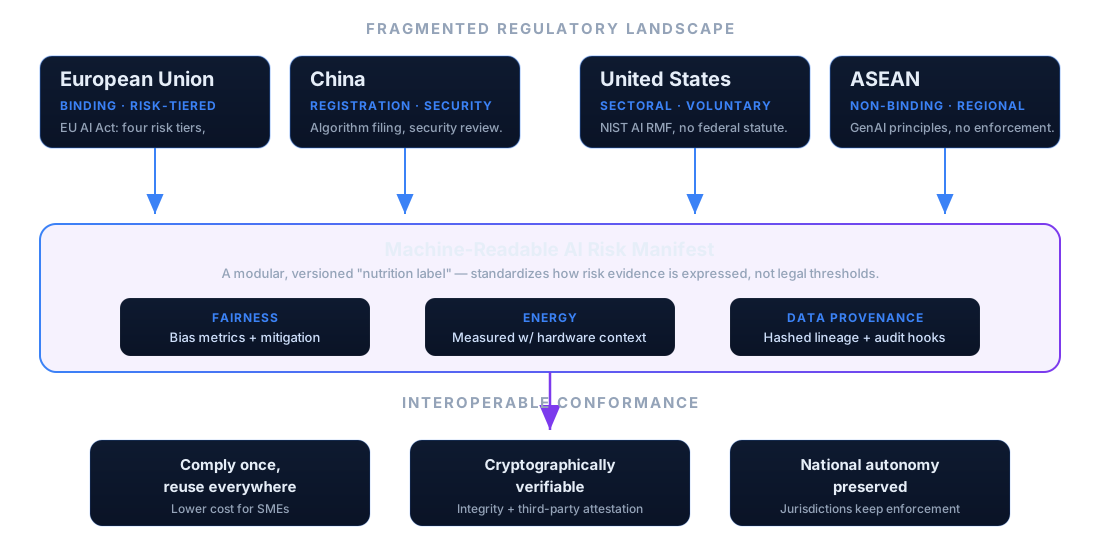
As AI systems integrate into critical global infrastructure, governance has fragmented into jurisdiction-specific laws and voluntary frameworks. We argue that AI governance must be built not on laws alone, but on ISO-like interoperability protocols that enable standardized, machine-readable risk communication across borders. We propose AI risk manifests (AI nutrition labels): modular, versioned artifacts that encode comparable metrics for bias, energy use, and data provenance, letting a system carry an interoperable compliance credential across jurisdictions.
The Standardization Vacuum
Similar architectures, data, and risk pathways are governed by sharply divergent regulatory philosophies. Without a shared technical language, the same system can be classified high-risk in one jurisdiction and low-risk in another, producing compliance uncertainty, duplicated assessments, and barriers to cross-border deployment. The result is structural fragmentation that acts as a non-tariff barrier, disproportionately burdening SMEs while favoring large incumbents.
These regimes reflect shared governance objectives but incompatible operational implementations. Fragmentation is not merely legal: there is no shared schema through which risk information can be consistently expressed and interpreted.
Our Position
Laws are indispensable for setting normative thresholds and enforcement authority, but they are insufficient to ensure consistent operationalization across heterogeneous AI systems and jurisdictions. We do not propose replacing existing regulatory regimes. We argue for a complementary technical layer that enables shared, machine-readable representations of AI risk.
In short: laws define what constitutes acceptable AI behavior; technical standards specify how compliance is demonstrated in practice. This approach supports domain-specific variation while preserving stable interoperability primitives.
Precedent: GDPR Succeeded Through Standardized Implementation
GDPR reshaped global data protection not from legal authority alone, but through reinforcement by interoperable technical standards. ISO 27001 supplied an Information Security Management System for structuring risk assessment and controls, while Privacy by Design embedded safeguards into system architectures. Together they turned an abstract legal mandate into concrete, auditable, repeatable practice.
GDPR requirement / principle
Corresponding ISO 27001 / Privacy by Design principle
Operational implication / benefit
Data Protection by Design & Default
Proactive not reactive; end-to-end security
Privacy embedded from initial design; continuous protection across the data lifecycle
Data Minimization
A.14 system acquisition / development / maintenance
Reduced data exposure; processing only necessary personal data
Lawfulness, Fairness, Transparency
A.5 information security policies; clear documentation
Clear data-handling processes; increased visibility and trust
Accountability
Systematic risk assessment; defined roles & responsibilities
Documented procedures; clear ownership for data protection
Security of Processing
A.9 access control; data encryption; incident response
Robust technical and organizational safeguards; effective incident management
Data Subject Rights
Operational procedures for data subject rights
Streamlined processes for fulfilling individual privacy requests
Caveat: the analogy is instructive, not equivalent
ISO 27001 governs organizational process; AI manifests must govern product outputs — how a deployed model behaves. AI behavior is stochastic and emergent: the same model may produce different outputs under distributional shift or novel prompts not covered at certification time. GDPR-style mechanisms are therefore necessary but insufficient without complementary, evolvable technical standards.
The Proposal: Machine-Readable AI Risk Manifests
We reframe the AI nutrition label from a descriptive summary into a structured, machine-readable AI risk manifest — analogous to a software bill of materials — that can be parsed, validated, and compared programmatically. It integrates into MLOps pipelines, procurement systems, and regulatory workflows while preserving the communicative clarity of the nutrition-label metaphor.
Minimum viable baseline: three dimensions in a shared vocabulary
01 — FAIRNESS
Bias
Report at least one global fairness metric and one subgroup metric (e.g., Equalized Odds, Disparate Impact) via a standardized schema. Document metric selection, proxy use, and known limitations.
must report
should stratify by group
02 — SUSTAINABILITY
Energy
Report inference-time energy under a standardized setting (task, hardware, protocol). Disclose full measurement context to normalize across hardware families. Distilled models link a teacher_model_ref.
must disclose hw context
03 — LINEAGE
Data provenance
Provide a dataset lineage summary: sources, geographic scope, licensing constraints. Support W3C PROV / ISO provenance, with optional poisoning-detection and integrity-check fields.
must hash dataset artifacts
These metrics do not harmonize legal thresholds. They establish a shared technical substrate so jurisdiction-specific obligations can be interpreted through one common interoperability layer.
A Proposed ISO-like Schema
The manifest standardizes core governance fields — model identification, purpose and deployment context, data provenance, performance and limitations, fairness, energy, security, transparency, and an explicit regulatory alignment crosswalk — while remaining modular and extensible. A single manifest functions as a reusable compliance artifact across jurisdictions; regulators apply their own enforcement logic to a common technical substrate.
Illustrative AI nutrition label (short-form, JSON)
A full protocol-level worked example — JSON and YAML representations, cryptographic attestation hooks, and a regulatory crosswalk — is provided in the paper appendix.
Regulatory crosswalk: manifest fields to obligations
Manifest field
EU AI Act-style obligation (concept)
NIST AI RMF
system.*
System identification, versioning, traceability for technical documentation and auditability
GOVERN
intended_use.*
Defined purpose, user context, and prohibited uses (scope control; misuse prevention)
MAP
risk_classification.*
Risk tiering and regime applicability (high-risk triggers, conformity expectations)
GOVERN / MAP
data_provenance.*
Data governance: origin, licensing, representativeness gaps relevant to bias and legality
MAP / MEASURE
evaluation.*
Evidence of performance and robustness testing under declared conditions
MEASURE
fairness.*
Bias monitoring and non-discrimination reporting (disaggregated metrics + mitigation)
MEASURE / MANAGE
privacy_security.*
Security/privacy controls, retention, and abuse monitoring consistent with risk controls
GOVERN / MANAGE
monitoring.*
Post-market monitoring: drift, incidents, corrective actions, defined fallback behavior
MANAGE
conformity.*, attestations.*
Conformity hooks: audit artifact hashes, third-party reports, signed attestations
GOVERN / MANAGE
Verifiability: integrity vs. truthfulness
Cryptographic attestations (signed hashes) guarantee integrity — values were not altered after signing — but not truthfulness, that the underlying evaluation was representative. The manifest is a minimum verifiable baseline, not a truth oracle. Key fields (data provenance, evaluation, attestation) are designed to be cross-verified by independent auditors who can re-run evaluations against the same hashed dataset artifacts. This shifts governance from narrative transparency to evidence-backed, machine-checkable assurance, and raises the cost of misrepresentation against Goodhart-style gaming.
Answering the Alternative Views
Alternative View 1
Standards lag behind innovation
Critics argue formal standards cannot keep pace with rapid model evolution and risk locking in suboptimal designs.
OUR REPLY
This assumes the absence of standards preserves agility. It overlooks the coordination costs that fragmented requirements already impose at scale, forcing developers to re-adapt the same system per jurisdiction. Modular, versioned standards evolve in parallel with technology.
Alternative View 2
Standards entrench incumbents
Compliance with formal schemas and audits may favor large firms and raise barriers for SMEs and new entrants.
OUR REPLY
Uncoordinated fragmentation already costs small actors more, forcing them to navigate multiple incompatible regimes. Outcome-oriented standards specify what must be demonstrated, not how — acting as enabling infrastructure, not gatekeeping. A single reusable artifact replaces many bespoke requirements.
Recommendations and Call to Action
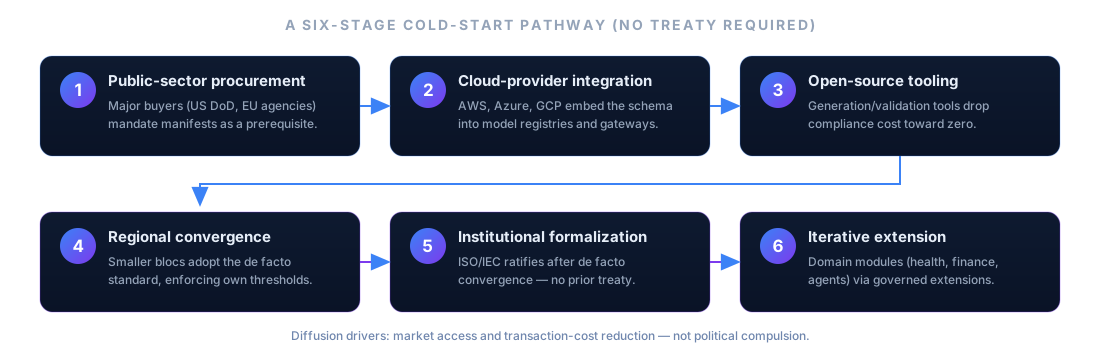
R1 — Establish a shared technical baseline. Standards bodies should prioritize a minimal, machine-readable baseline for AI risk manifests reusable across regimes, anchored in existing institutions (ISO, IEC) to avoid governance duplication while enabling jurisdiction-specific enforcement.
R2 — Tie standards to incentives, not only mandates. Governments, funders, and large procurers should reward adherence through procurement criteria and certification pathways. Incentive-based adoption accelerates uptake while preserving flexibility and lowering entry barriers for smaller actors.
R3 — Invest in inclusive, multi-stakeholder stewardship. Governance must include transparency, balanced participation, and capacity building, particularly for low-resource contexts, with sustained roles for academia, civil society, and open-source communities.
R4 — Fund and formalize the science of AI evaluation. The manifest's utility depends on scientifically valid, reproducible metrics. Invest in robust fairness benchmarks, hardware-agnostic energy protocols, and rigorous automated red-teaming so the manifest enables accountability rather than compliance theater.
Overcoming the cold-start problem
Full global consensus is neither required nor expected. Partial convergence around a minimal interoperable schema is sufficient for procurement, auditing, and compliance workflows. Diffusion proceeds through market access and transaction-cost reduction rather than treaty negotiation.
Citation
Please cite the paper as below:
@inproceedings{
wasi2026aigovernance,
title={Position: {AI} Governance Needs {ISO}-like Interoperability Protocols, Not Just Laws},
author={Azmine Toushik Wasi and Mst Rafia Islam and Mahfuz Ahmed Anik and Taki Hasan Rafi and Md Manjurul Ahsan and Dong-Kyu Chae},
booktitle={Forty-third International Conference on Machine Learning Position Paper Track},
year={2026},
url={https://openreview.net/forum?id=TE3ceHd4YU},
note={Spotlight}
}